95% of AI Pilots Fail — What the 5% Do Differently (And How CSPs Can Cash In)


The AI gold rush is in full swing. Enterprises have poured an estimated $30–40 billion into generative AI initiatives. Microsoft alone reports 218 million Copilot users. The market is projected at $63 billion and climbing.
But here's the number no one wants to talk about at your next sales meeting.
The MIT Study That Should Concern Every Partner
In August 2025, MIT's NANDA initiative published The GenAI Divide: State of AI in Business 2025 — a report based on 150 executive interviews, a survey of 350 employees, and an analysis of 300 public AI deployments. The headline finding was stark:
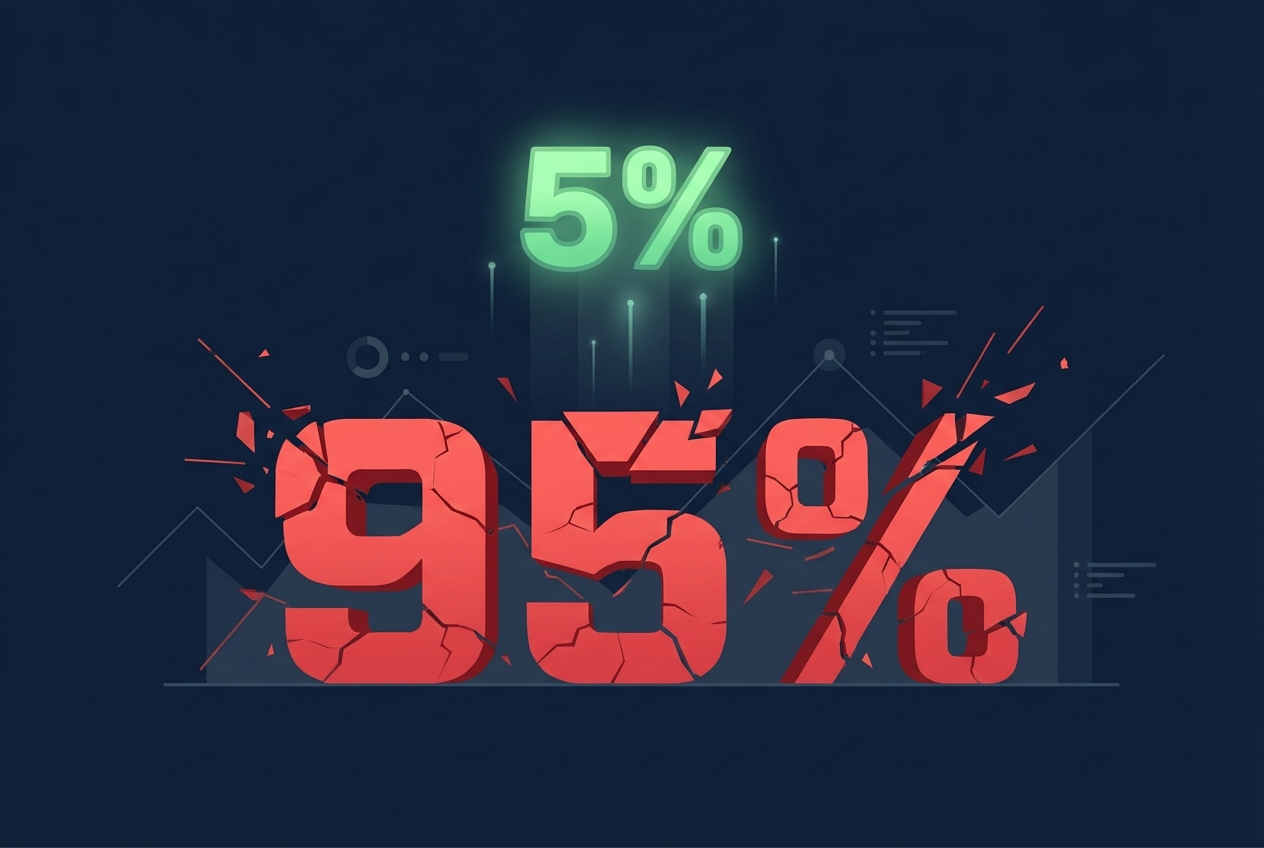
95% of enterprise AI pilot programs fail to deliver measurable financial returns.
Not "underperform." Not "need more time." Fail. Zero P&L impact.
For Microsoft Cloud Solution Providers, this isn't just a statistic — it's a massive opportunity hiding in plain sight. Your customers are struggling with AI. They need a partner who can guide them past the 95% failure rate and into the 5% that actually works.
Why 95% of AI Projects Stall
The MIT researchers identified six root causes. Notice what's not on the list: the quality of AI models.
1. Lack of Organizational Readiness
Companies jump straight to deploying Copilot licenses without preparing their organization. No change management. No executive sponsorship beyond the initial purchase order. No clear ownership of outcomes.
As MIT lead author Aditya Challapally told Fortune: "The 95% failure rate represents the clearest manifestation of the GenAI Divide." The issue isn't the technology — it's the gap between what AI can do and what organizations are ready to absorb.
2. Poor Problem Selection
Here's an interesting finding: more than half of GenAI budgets go to sales and marketing tools, yet MIT found the biggest ROI comes from back-office automation — eliminating outsourced processes, cutting agency costs, and streamlining operations.
Companies are deploying AI where it's exciting, not where it's effective.
3. Poor Governance & Oversight
The report highlights "shadow AI" as a widespread problem — employees using unsanctioned tools like ChatGPT without any guardrails. Meanwhile, data security incidents from GenAI applications have increased 1.5x, rising from 27% in 2023 to 40% in 2024, according to the Data Security Index.
Over 80% of leaders cite leakage of sensitive data as their main concern with GenAI. Nearly half (48%) expect to continue banning all GenAI use in the workplace. That's not a governance problem — it's a governance vacuum.
4. Data Quality & Access Challenges
AI is only as good as the data it can reach. Microsoft Copilot needs clean SharePoint sites, properly permissioned files, and organized data structures. Most organizations have none of these things.
5. Skills & Alignment Gaps
Forbes reported that MIT's research found "pilots stall because most tools cannot retain feedback, adapt to context, or improve over time." But it's not just the tools — it's the people. Line managers need to drive adoption, not just central IT or AI labs.
6. Mismanaged Expectations
Companies expect AI to transform their business in a quarter. When it doesn't, they label it a failure and move on — or worse, they never define what "success" looks like in the first place.
What the 5% Do Differently
The MIT report isn't all doom and gloom. The 5% that succeed share clear patterns that every CSP can learn from — and sell.
They Start with One Pain Point
"Startups that succeed with AI have seen revenues jump from zero to $20 million in a year," Challapally told Fortune. "It's because they pick one pain point, execute well, and partner smartly."
The same principle applies to enterprise Copilot deployments. Don't roll out to the whole company on day one. Find the team that spends 3 hours a day in email, or the department drowning in meeting summaries, and start there.
They Buy, Not Build
One of MIT's most striking findings: purchased AI solutions succeed at nearly twice the rate of internally built systems. Externally procured tools and vendor partnerships succeed about 67% of the time, while internal builds succeed only one-third as often.
This is your competitive advantage as a CSP. You're not asking customers to build from scratch — you're deploying proven Microsoft solutions with expert guidance.
They Measure from Day One
The successful 5% establish baselines before deployment and track specific metrics: time saved, rework reduction, response speed. They don't wait six months to ask "is this working?" — they know within weeks.
They Empower Line Managers
MIT's research found that success happens when line managers — not just central AI labs — drive adoption. The people closest to the work know where AI can save the most time. Give them ownership.
The Partner Opportunity: Turning Failure into Revenue
Here's where it gets interesting for Microsoft CSPs.
According to the 2025 Forrester Total Economic Impact study, Microsoft Modern Work partners who lean into AI are seeing extraordinary results:
- 152% increase in direct AI revenue year-over-year
- 72% growth in AI advisory services
- 48% services attach rate on Copilot deals
- $26 per user per month in services and solutions revenue
- Solution development revenue growing fastest, driven by AI agents
As one partner in the study put it: "Across all solution areas, our AI business has grown twice as fast as everything else."
The math is straightforward. If your customers are going to spend money on AI — and they are — they can either join the 95% who waste it, or work with a partner who helps them join the 5% who profit from it.
A Framework That Works: Assess → Mobilize → Scale
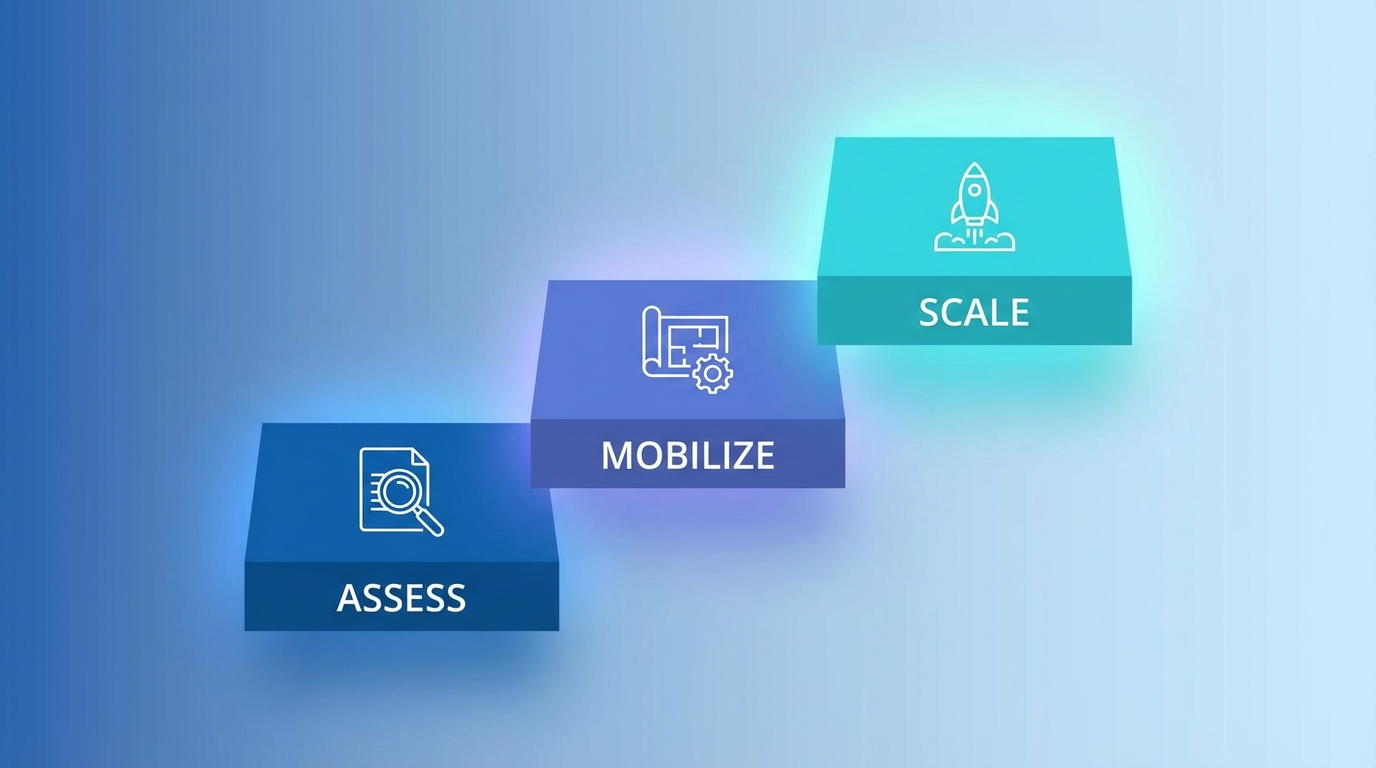
Based on what's working in the field, here's a three-phase approach that addresses every root cause the MIT study identified:
Phase 1: Assess
Addresses: Poor Problem Selection + Mismanaged Expectations
- Identify specific GenAI use cases with measurable business value
- Conduct ROI / TCO analysis before deployment
- Evaluate workforce readiness — who's ready, who needs training, who's resistant?
- Set concrete success metrics and timelines
Phase 2: Mobilize
Addresses: Data Quality + Governance + Organizational Readiness
- Implement data security and privacy controls (Microsoft Purview is your friend here)
- Stage and curate data — clean up SharePoint, fix permissions, organize file structures
- Build the landing zone: identity, compliance, and governance foundations
- Start with low-code AI environments for quick validation
- Create mockups and demos to build executive buy-in
Phase 3: Scale
Addresses: Skills Gaps + Sustained Adoption
- Deploy minimum viable product (MVP) to a focused user group
- Build pro-code AI environments for advanced use cases
- Deploy and scale the AI model across the organization
- Measure, tune, and report on ROI continuously
- Expand from one use case to many — success breeds adoption
The Security Angle You Can't Ignore
Here's the kicker: AI adoption without security is a liability, not an asset.
- Small businesses are 4x more likely to be a victim of a cybersecurity breach than large enterprises (Verizon 2025 DBIR)
- The average cost of a cyberattack for small businesses is $250,000 (Microsoft SMB CyberSecurity Report)
- 1 in 5 data security incidents happen because of insiders (Forrester, March 2024)
- Ransomware was involved in 44% of all breaches in the 2025 DBIR reporting period
Every Copilot deployment should include a conversation about Microsoft Defender, Purview, and Entra ID. It's not just good practice — it's a revenue multiplier. And right now, Microsoft is offering promotional pricing on the security stack (Purview Suite at 50% off, Defender + Purview bundle at 33% off) through June 30, 2026.
March Madness Offer: Automate Your CSP Billing Before the Month Ends
March Madness Offer: Automate Your CSP Billing Before the Month Ends
While your customers are sorting out their AI strategy, here's a reminder: the infrastructure you use to bill, manage, and scale those Copilot deployments matters just as much as the deployments themselves.
If Microsoft CSP billing is still manual — spreadsheets, WHMCS, or a legacy platform — you're leaving money and time on the table every single month.
Hybr's March Madness programme is live until 31 March 2026, and it's built specifically for MSPs and CSPs who want to modernise without the usual switching headache:
- 25% off your annual Hybr plan
- Free CSP billing migration — customer accounts, subscriptions, pricing tiers, billing history — all moved for you
- £0 setup fee and fast-track onboarding designed to get your first customer bill running before the end of the month
- White-labelled cloud marketplace setup so your customers can self-serve from day one
- A 1:1 CSP margin optimisation session with a Hybr billing expert
Partners report up to 300% productivity gains hybr after automating their CSP billing workflows — which means more time for the AI advisory work that actually drives revenue.
This offer closes 31 March. After that, standard rates and timelines apply.
👉 Claim Your March Madness Benefits →
What to Do This Week
If you're a Microsoft CSP reading this, here are three things you can do right now:
- Audit your Copilot customers. How many have deployed but aren't measuring ROI? That's your advisory services pipeline.
- Build an "AI Readiness Assessment" offer. Use the Assess → Mobilize → Scale framework above. Charge for discovery. Your customers will pay for clarity.
- Lead with security in every AI conversation. Copilot without governance is a data breach waiting to happen. Bundle Defender and Purview into every proposal.
- Take the March Madness deal before 31 March. If your CSP billing is still manual, this is the lowest-cost, lowest-risk moment to fix that — free migration, 25% off, and expert setup included. → Claim it here
The $63 billion AI market isn't slowing down. The question isn't whether your customers will adopt AI — it's whether they'll be in the 95% that waste their investment, or the 5% that turn it into measurable business value.
That's the gap you were built to fill.
Sources
- MIT NANDA, The GenAI Divide: State of AI in Business 2025 (August 2025)
- Fortune: MIT report — 95% of generative AI pilots at companies are failing
- Forrester: The Impact of AI on Microsoft Modern Work Partner Revenue (2025)
- Verizon 2025 Data Breach Investigations Report
- Data Security Index 2024
- Microsoft SMB CyberSecurity Report
CSP Billing Ultimate 2026
Elite Growth Platform for Ambitious Businesses