Your Customers Are Unprotected: The Massive Security Gap CSP Partners Can't Afford to Ignore

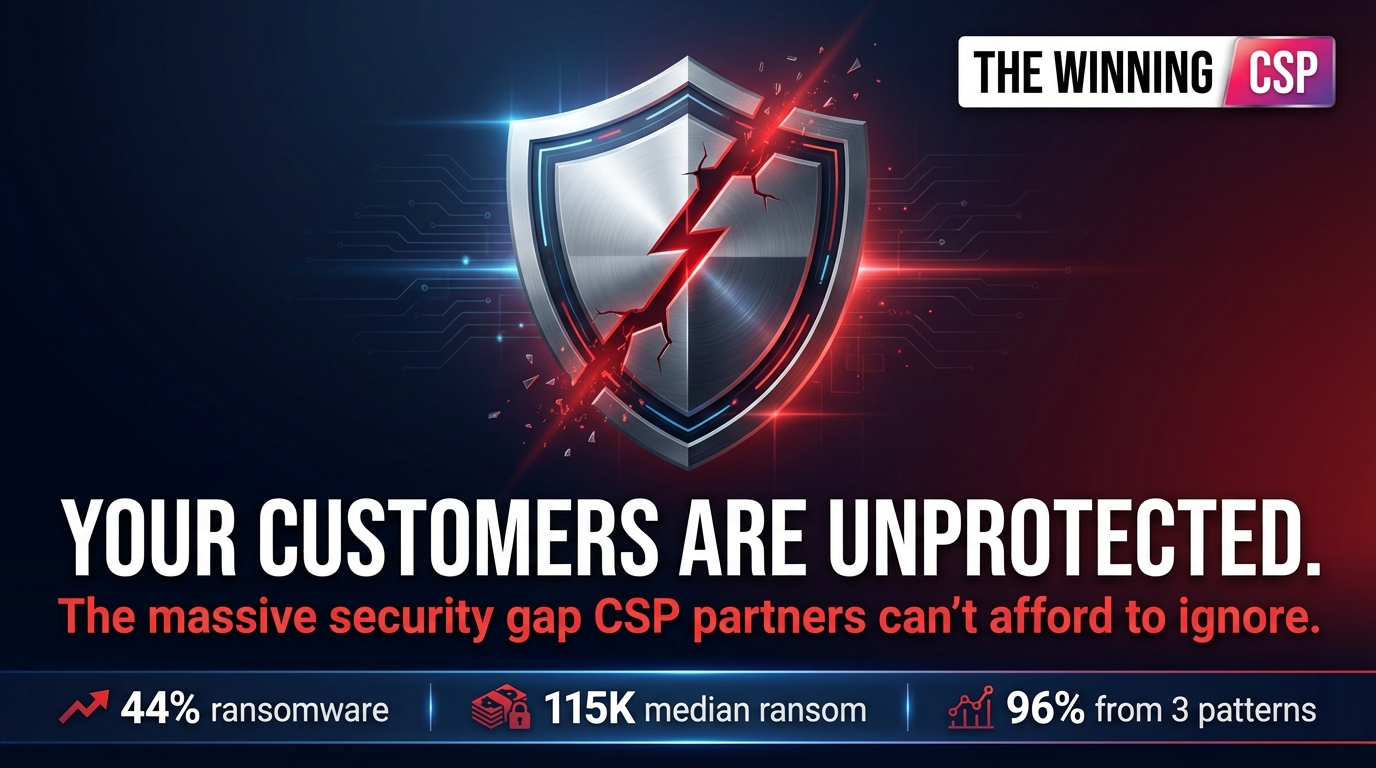
44% of all breaches now involve ransomware. Your SMB customers are in the crosshairs — and most of them are running naked.
Let that sink in. Nearly half of the 12,195 confirmed breaches analyzed in the Verizon 2025 Data Breach Investigations Report involved ransomware. The median ransom payment hit $115,000. And for SMBs? The total cost of a breach ranges from $120,000 to $1.24 million per incident, according to BD Emerson's February 2026 analysis.
Meanwhile, Defender attach rates across the CSP channel remain stubbornly low. Most M365 customers are sitting on licenses that include basic protections they've never activated — while the advanced security stack that could actually stop modern attacks goes unsold.
Here's the thing: Microsoft knows this. That's why FY26 has the most aggressive security incentives the partner channel has ever seen. And some of those promos expire June 30, 2026.
This isn't a "nice to have" conversation. It's a revenue opportunity with a deadline.
The SMB Security Crisis Is Worse Than You Think
The Verizon 2025 DBIR paints a bleak picture for small and midsize businesses:
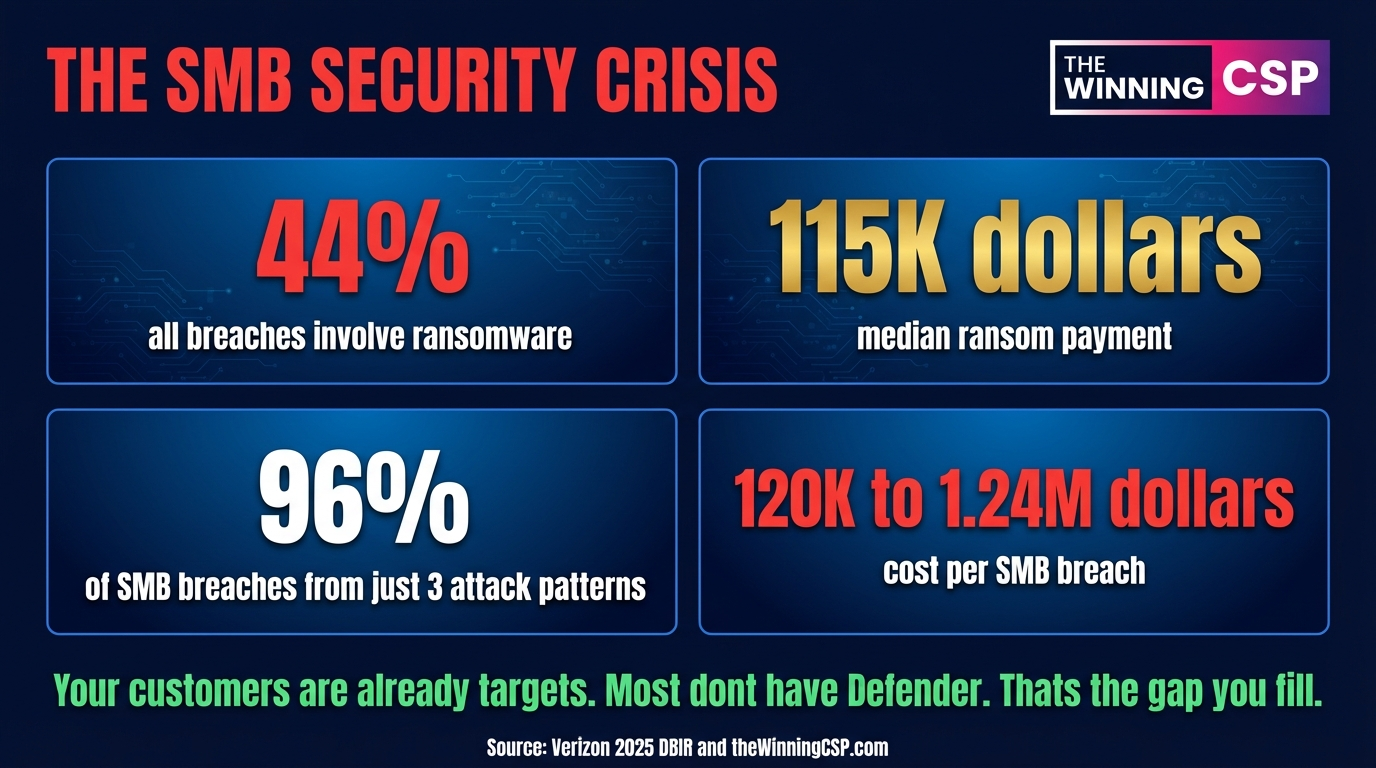
- 96% of SMB breaches come from just three attack patterns: system intrusion, social engineering, and basic web application attacks
- Ransomware appeared in 44% of all breaches analyzed — up sharply from prior years
- Median ransom payment: $115,000 — a number that would cripple most SMBs
- Breach costs range from $120K to $1.24M per incident for small businesses (BD Emerson, Feb 2026)
And it's getting worse. GenAI is supercharging phishing attacks — making them more convincing, more personalized, and harder to catch with traditional filters. Data security incidents are rising as employees feed sensitive information into AI tools without guardrails.
Your SMB customers aren't being targeted because they're valuable individually. They're targeted because they're easy. Most lack dedicated security staff. Many are running default M365 configurations with no advanced threat protection. They're the soft targets in every attacker's playbook.
The question isn't whether your customers will face an attack. It's whether they'll survive one.
Microsoft Defender: Not Just Antivirus Anymore
Here's what too many partners — and their customers — still don't understand: Microsoft Defender isn't a single product. It's four integrated security pillars under one umbrella, with a correlation engine that ties them together into something genuinely powerful.
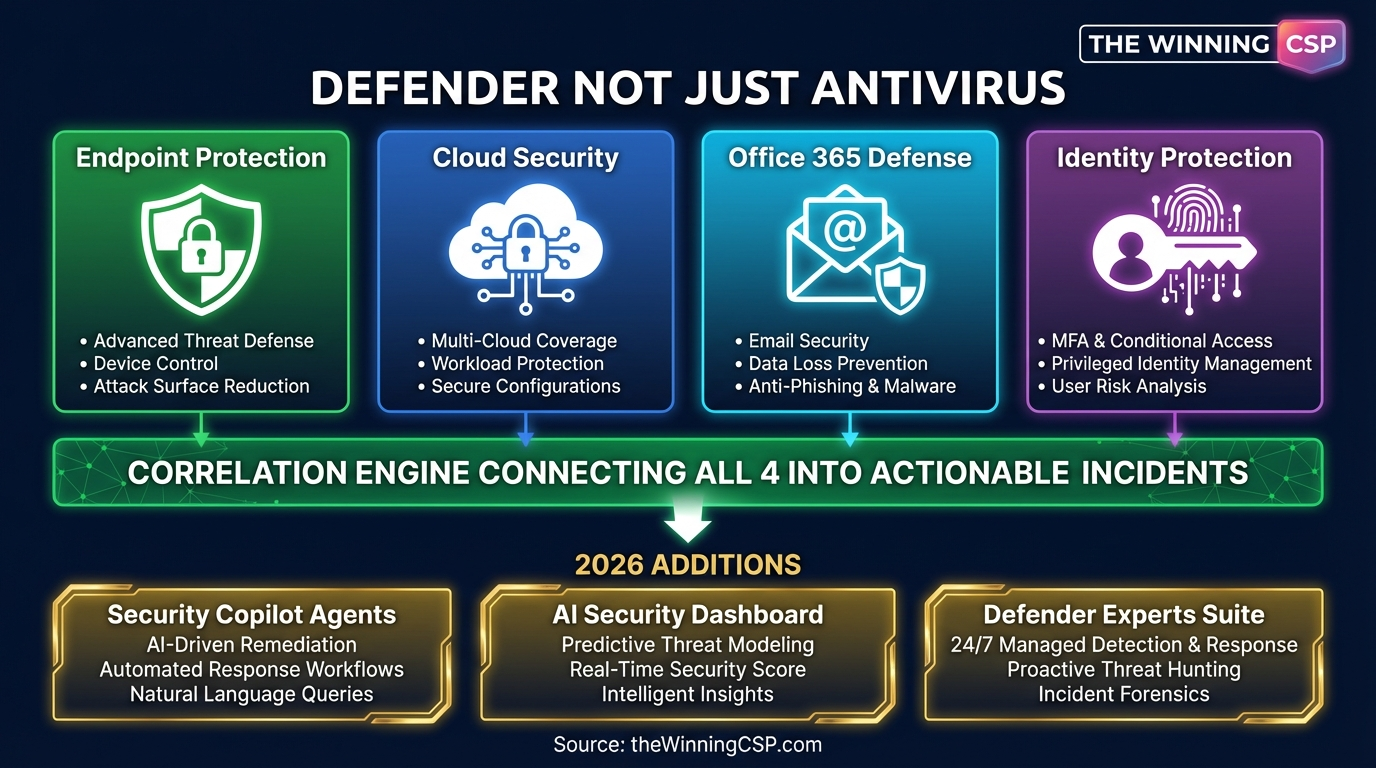
The Four Pillars
Defender for Endpoint — Next-gen antivirus plus endpoint detection and response (EDR). This is the foundation: real-time protection, attack surface reduction, automated investigation and remediation across Windows, macOS, Linux, iOS, and Android. Defender for Office 365 — Anti-phishing, anti-malware, and safe attachments/links for Exchange, Teams, and SharePoint. As of January 2026, this is now included in M365 E3 — meaning your E3 customers already have it. They just need to turn it on. Defender for Identity — Monitors on-premises Active Directory signals and integrates with Entra ID to detect identity-based attacks: lateral movement, privilege escalation, compromised credentials. This is the piece most SMBs are completely missing. Defender for Cloud — Cloud security posture management for Azure, AWS, and GCP workloads. As customers move infrastructure to the cloud, this becomes the security control plane.
The Secret Weapon: Correlation
Each pillar is useful on its own. Together, they're transformative. Defender's correlation engine connects signals across endpoints, email, identity, and cloud into unified incidents. An attacker who phishes an employee, steals their credentials, moves laterally through the network, and deploys ransomware shows up as one correlated incident — not four disconnected alerts.
That's the pitch to customers: you're not buying four products. You're buying one security platform that sees the entire attack chain.
What's New in 2026
Microsoft has been shipping aggressively:
- Defender Experts Suite (GA, January 2026) — AI-powered, expert-led managed detection and response. For customers who don't have a SOC, this is Microsoft's security team watching their environment 24/7.
- Security Copilot Agents (Preview, March 2026) — AI agents that automate SOC workflows. The Security Analyst Agent and Alert Triage Agent handle the repetitive investigation work that burns out security analysts. For partners offering managed security services, this is a force multiplier.
- AI Security Dashboard (March 2026) — A unified view of AI-specific threats, free for security customers. As GenAI adoption explodes, this gives visibility into AI-related risks that most organizations are flying blind on.
These aren't future roadmap items. They're shipping now.
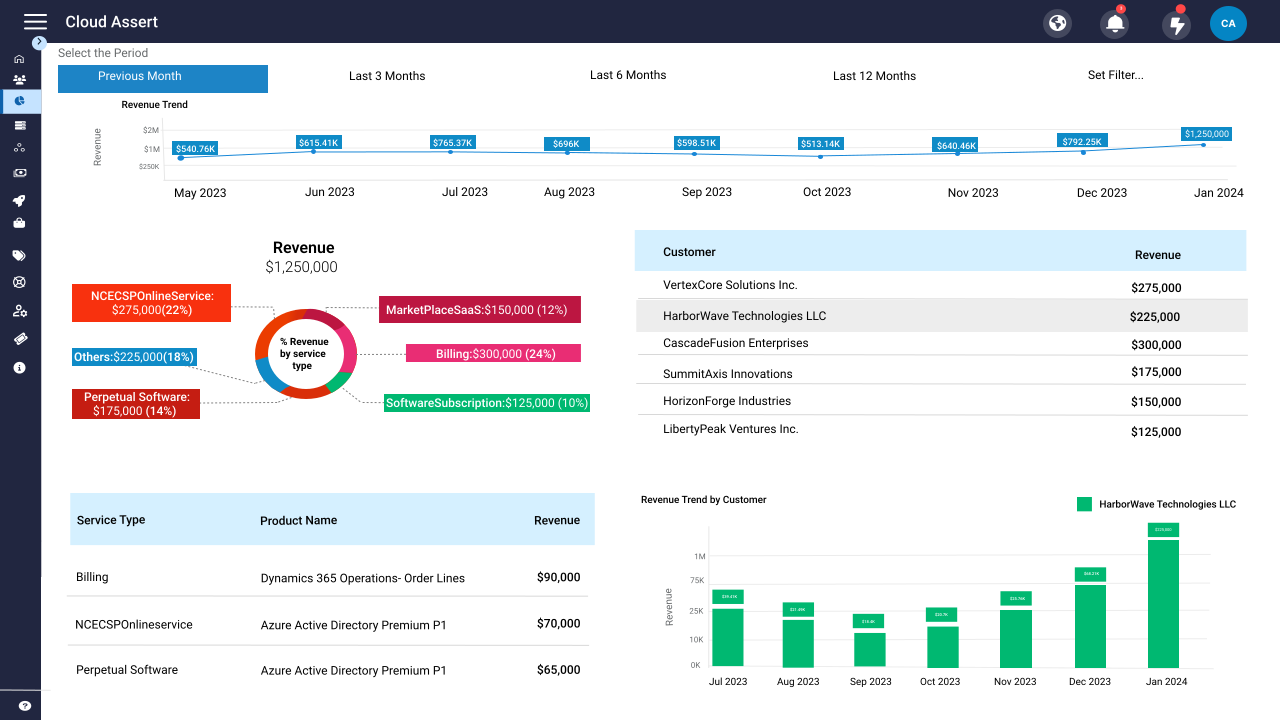
Take the March Madness deal before 31 March. If your CSP billing is still manual, this is the lowest-cost, lowest-risk moment to fix that — free migration, 25% off, and expert setup included. → Claim it here
The Partner Revenue Opportunity
Let's talk money.
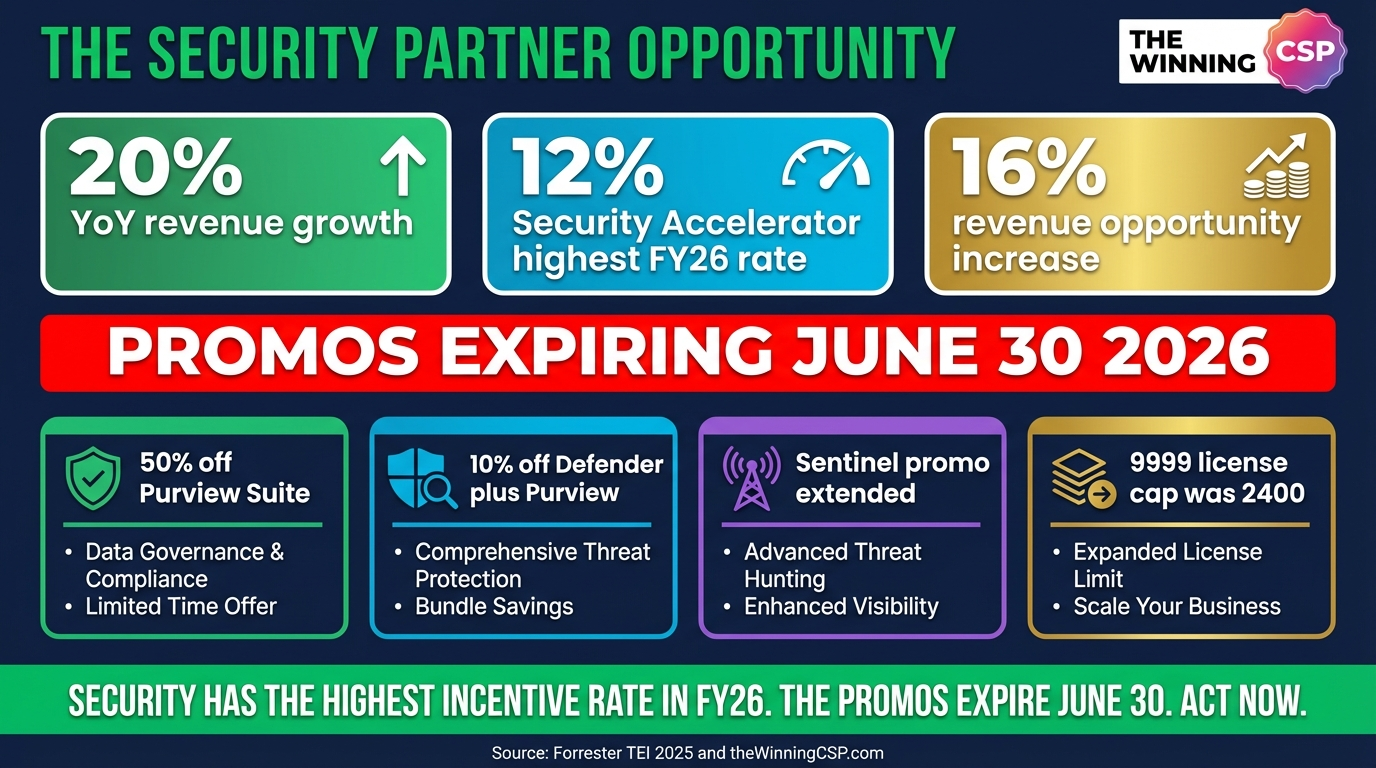
Forrester's latest research shows 20% year-over-year revenue growth for Microsoft security partners. The security revenue opportunity is up 16% YoY when attach rates are applied to the installed base. Security is the fastest-growing solution area in the Microsoft ecosystem — and it's not close.
The Incentive Math
Microsoft's FY26 incentive structure makes the economics even more compelling:
- 12% Strategic Accelerator for security — the highest rate across all solution areas. Not modern work. Not Azure. Security.
- CSP promo license cap increased from 2,400 to 9,999 seats (March 2026) — removing the ceiling that limited larger deals
- Unlimited Security Immersion Briefings — no execution caps, with 20 open submissions as of February 2026
- New Business Premium security track for 50–300 license customers — a structured path for the SMB sweet spot
- Step-up pricing for Entra ID P2 and Defender for Endpoint P2 via CSP (January 2026) — removing the friction of moving customers from lower tiers
Build Your Own Revenue Math
Let's run the numbers on a single 200-seat M365 Business Premium customer:
| Line Item | Per User/Month | Monthly Total |
|---|---|---|
| M365 Business Premium (existing) | $22 | $4,400 |
| + Defender Suite (promo pricing) | ~$10 | $2,000 |
| + Purview Suite (50% promo) | ~$5 | $1,000 |
| New monthly recurring | $3,000 |
That's $3,000/month in additional recurring revenue from a single existing customer — before partner margin and before the 12% security accelerator incentive.
Now multiply across your customer base. If you have 10 customers averaging 200 seats each:
- $30,000/month in new security MRR
- $360,000/year in additional recurring revenue
- Plus 12% accelerator incentive on top
- Plus margin on implementation and managed services
And this is just the starting point. Each Defender deployment creates natural upsell paths (more on that below).
Promos and Programs Running NOW
Several of these incentives have hard expiration dates. Here's what's live and when it ends:
Expiring June 30, 2026
- Purview Suite — 50% off for Copilot customers. Half price on compliance and data governance. This is the easiest attach sale in the portfolio right now.
- Defender + Purview Suites — 10% off on 3-year CSP terms. Lock in long-term commitments at a discount.
- Microsoft Sentinel promo — extended to June 30, 2026. Cloud-native SIEM at promotional pricing.
Running Through December 2026
- Defender Experts Suite promo — extended runway on Microsoft's managed detection and response offering.
No Expiration (But Act Now)
- Security Immersion Briefings — unlimited, no caps. Use these to get customers into Microsoft-led security workshops. It's free pipeline generation.
- Business Premium security track — structured selling motion for 50–300 seat customers.
June 30 is 93 days away. If you haven't started these conversations with customers, the window is closing.
Take the March Madness deal before 31 March. If your CSP billing is still manual, this is the lowest-cost, lowest-risk moment to fix that — free migration, 25% off, and expert setup included. → Claim it here
The Expansion Playbook: From Defender to Full Security Practice
Here's where the compounding revenue story gets interesting. Defender isn't the end of the security conversation — it's the beginning.
Every Defender deployment creates natural next steps:
The Upsell Chain
Defender → Entra ID P2 — Once customers see identity-based threats in Defender, the conversation about advanced identity protection writes itself. Risk-based conditional access, privileged identity management, access reviews. Entra ID → Conditional Access — Modern identity requires modern access policies. Device compliance, location-based access, real-time risk evaluation. This replaces legacy Group Policy for the cloud era. Conditional Access → Intune — You can't enforce device compliance without device management. Intune becomes the natural next step for managing endpoints, deploying policies, and ensuring devices meet security baselines. Intune → Azure Security — As customers mature, their cloud footprint grows. Defender for Cloud, Azure Firewall, Azure Sentinel — the security perimeter extends into infrastructure.
The Modernization Story
Frame it as a modernization journey, not a product pitch:
| Legacy | Modern | Revenue Driver |
|---|---|---|
| Active Directory | Entra ID | Entra ID P2 licenses |
| Group Policy | Conditional Access | E5 Security or standalone |
| SCCM | Intune | Intune P2 or Suite |
| On-prem firewall | Defender for Cloud | Azure consumption |
| Third-party SIEM | Microsoft Sentinel | Azure consumption |
Each step replaces aging infrastructure with cloud-native alternatives — and each step generates recurring revenue for you.
The partner who deploys Defender today becomes the trusted security advisor tomorrow. And trusted security advisors don't get price-shopped on license renewals.
Your Action Checklist
Don't let this sit in a "we should do that someday" pile. Here's what to do this week:
1. Audit your customer base. Pull a report of every customer on M365 Business Premium, E3, or E5. How many have Defender fully deployed? How many have Entra ID P2? How many are still on basic security defaults? The gap between what they own and what they use is your pipeline. 2. Run the revenue math. Take your top 10 accounts. Calculate the additional MRR from Defender Suite + Purview Suite at promo pricing. Add the 12% accelerator. Share that number with your sales team. 3. Book Security Immersion Briefings. There are no caps. Submit your top prospects. Let Microsoft's team do the heavy lifting on education while you own the relationship. 4. Build a promo countdown campaign. June 30 is real. Create urgency. Send targeted emails to customers highlighting the promos that apply to their current licensing. 5. Train your team on the expansion playbook. Every Defender conversation should include the Entra → Intune → Azure path. Plant the seeds now for next quarter's pipeline. 6. Start with Defender for Office 365 activations. For E3 customers, it's already included as of January 2026. Activating what they already own builds trust and opens the door to everything else.
Take the March Madness deal before 31 March. If your CSP billing is still manual, this is the lowest-cost, lowest-risk moment to fix that — free migration, 25% off, and expert setup included. → Claim it here
The Bottom Line
The data is clear: SMBs are being breached at record rates, the attacks are getting more sophisticated, and most customers are dramatically underprotected. At the same time, Microsoft is offering the most aggressive security incentives the channel has ever seen — 12% accelerator rates, 50% off promos, unlimited briefings, and new AI-powered capabilities shipping monthly.
This is a rare alignment of customer need, vendor incentive, and market timing. Partners who build their security practice now will compound that advantage for years. Partners who wait will watch the promos expire and the early movers lock up the customer relationships.
The June 30 deadline isn't arbitrary pressure. It's the edge of the window.
Don't let your customers — or your business — be on the wrong side of it. --- Sources: Verizon 2025 Data Breach Investigations Report; BD Emerson SMB Breach Cost Analysis (Feb 2026); Forrester Microsoft Security Partner Economics Report; Microsoft Partner Center FY26 Incentive Guides; Microsoft Security Blog. Have questions about building your security practice? Contact us or drop a comment below.
CSP Billing Ultimate 2026
Elite Growth Platform for Ambitious Businesses